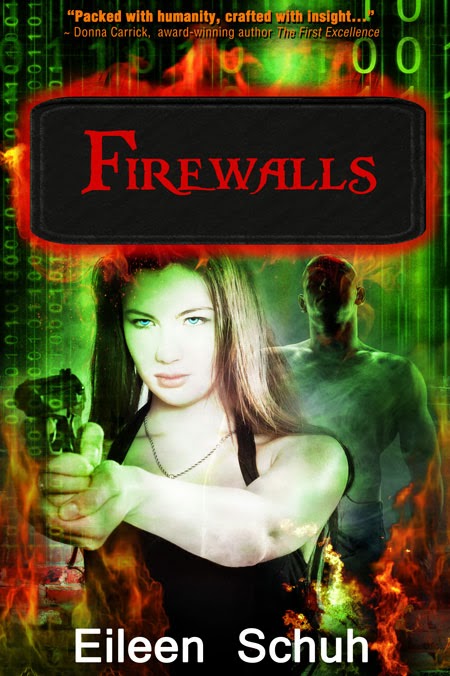
Legalities and illegalities play big roles in all my novels. The BackTracker Series centers around the lives of a group of officers with the Northern Alberta Police Service. Although most are morally upright and very dedicated to their jobs, they are also emotional, vulnerable and human. In this scene from FIREWALLS Book 3 in the Series, young Constable Katrina Buckhold struggles with her romantic feelings for the much older Corporal Chad Leslie, a struggle so intense it eventually requires intervention from Calgary's men in blue.
 |
| Katrina & Chad |
He didn’t even move when she wound up and tossed the
wine at him. She flung the empty glass to the floor and half-rose from the bench. No longer feeling the need to whisper,
she began to yell. “Why are you sitting here telling me this? Can’t you fucking
leave me alone?” With one sweep of her hand, the crystal salt and pepper
shakers joined the wineglass shards on the floor. By the time she decided to
leave, the manager was at Chad’s side.
“Get her under
control!” the guy demanded. “Or I’m calling the cops!”
“I can’t control
her,” Chad said. “Do whatever you have to do.”
“Fuck you,
Chad!” Katrina scrambled off the bench, cast the manager an apologetic glance
and headed for the exit. She wasn’t sure if it was low blood sugar or emotional
turmoil, but she had trouble getting her feet to take her where she wanted. It
seemed she managed to knock something off every table she passed. When she
finally got to the door, she fell into the arms of a uniformed police officer.
The rough feel of the man’s jacket against her cheek reminded her of her father
and she wrapped her arms around his waist and began crying.
“Take her to the
car,” she heard the officer’s partner order. “I’ll check what’s going on
inside.”
The cool evening
air felt good and Katrina pulled away from the officer, tilted her head to the
heavens, and felt the breeze brushing at her tears.
“You can wait in
the car until my partner comes back,” the officer said, opening the rear door
of the police cruiser.
“No, it’s okay.
The fresh air feels good.”
“Are you old
enough to have been drinking?”
“Yes, but I
wasn’t drinking.”
“Weren’t
drinking? Can I see your ID?”
Katrina rummaged
in her vest pocket for her driver’s licence. “For fuck sake, where is it? I
know I have it. I had to show it in there. I told the idiot I don’t drink, but
he made me give it to him anyways. Idiot!”
She patted down
her pant pockets and then tried her vest again and pulled it out. “Oh, it is
here. Right where I put it. I always have it handy, you know. Because I’m
always getting asked for it. People don’t believe my age. Some idiot in class
today asked if I was finished high school for the summer! People are always
saying I look older than I am.”

“Older?” the
officer asked, shining his flashlight on her ID.
“Younger,” she
corrected. “How old do you think I look?”
“Oh, I don’t
think you look old.” He handed her the licence.
“That’s not what
I meant!” Katrina felt tears gushing forth once again. “People are always
taking my words the wrong way!”
“I understand
what you meant. Just have a seat in the car. You’re a little unsteady on your
feet.” Katrina took him up on the offer and he closed the door and then got in
behind the wheel. “So, what happened tonight in there?” He nodded toward the
restaurant.
“You ought to
arrest him. He’s stalking me.”
“Who’s stalking
you?”
“Chad. He’s a
married man, fifteen years older than me, and he’s stalking me. He won’t leave
me alone and it’s not even my birthday.”
“What do you
mean that he’s stalking you?”
“He’s drives
three hours one way to tell me his wife is screwing around on him. Why the fuck
does he think I care? I don’t feel so good. Take me to the hospital.”
“Don’t you be
getting sick back there!” the officer warned. “Why did you drink so much?”
“I didn’t drink.
I never do. My mother was an alcoholic and her mother was, too. She died from
it and then mom killed dad because she was driving drunk. I never drink. I’m
not feeling good. At all, good. At all.”
“Do you have a
medical condition?” the officer asked. “Epilepsy? Diabetes?”
“No, just
shortness.”
“Shortness of
breath?”
“No, just the
regular-type shortness. Take me home, now. I think I’ll be okay if I can just
sleep for a while.”
“Where’s home?”
“Three hours,
that way.” She pointed around in a circle. “Which way is north? That way! Take
me that way!”
“How can you say
you don’t drink when you’re obviously intoxicated?”
“If I’m drunk,
and I just might be, it kind of feels like the one time I drank. I was
thirteen, you know, and my mom and dad both got killed and I drank a bottle of
rye. A whole fucking bottle of Gibson’s
Finest. That’s kind of how I feel. If I’m drunk, it’s because Chad spiked
my drinks! You ought to arrest him for that. That’s not legal you know.”
“Chad spiked
your drinks?”
“He must have,
if I’m drunk. Because I was drinking Caesars. I thought I was. It’s what I
ordered. Virgin Caesars, you know, like no alcohol.”
The other
officer climbed into the front seat and Katrina couldn’t make out the words
that passed between them.
“We’ll take you
down to the station to sober up,” the younger officer offered.
“No,” Katrina
moaned. “I have an idea, take me to my hotel. It’s closer than my home. Not
such a long drive for you.”
“I can’t do
that,” the officer explained. “The waiter claims you assaulted him. He wants to
press charges.”
“Assaulted him?”
Katrina wailed.
“Says you threw
a wineglass at him. Cut his leg.”
“No, No. I
didn’t do that,” Katrina protested. “Where’s Chad? He can tell you I didn’t do
that! I wouldn’t throw something at a waiter! No!” The cop car pulled away from
the curb. “Oh, fuck.” Am I in trouble
now.
_______________
“I can promise you
Katrina will get under your skin and into your heart.”
"FIREWALLS takes
you on a journey and leaves you to clean up your own mess.”
"Schuh
is raw, she's real, and she packs one hell of a punch."
"A tale
of comfort and hope that we, too, can slay our own dragons."
"A
gritty, fast paced thriller."